BLOG
When Maintenance Data Is a Week Old, So Are Your Decisions


A global chemical manufacturer recently discovered its leadership was making million-dollar maintenance calls on data that was already a week stale by the time it reached them. That is not a one-off. It is close to standard practice across petrochemical and chemical manufacturing, where maintenance still runs on manual tracking, site-by-site spreadsheets, and reports that lag reality.
The cost of that lag is measurable, and it is large. Siemens' 2024 True Cost of Downtime report puts unplanned downtime at $1.4 trillion a year across the world's 500 largest companies, a 62% increase since 2019, despite fewer incidents actually occurring. In asset-intensive sectors like chemicals and oil and gas, a single hour of downtime can run into the hundreds of thousands of dollars. McKinsey's most recent maintenance and operations survey found 62% of operators report above-inflation increases in maintenance costs, even as 99% of them have run some kind of maintenance transformation in the past five years. The investment is happening. The results mostly are not.
Part of the gap is process, not technology. McKinsey found that mature, reliability-centered maintenance organizations put 70 to 85% of technician hours into preventative work. The average operator in its survey managed only 51%. The rest goes to reactive fixes, the expensive kind, discovered late, often after a piece of equipment has already failed.
The other part is talent. 73% of operators struggle to recruit maintenance technicians, and 55% have no formal system for transferring what experienced technicians know before they retire or move on. Every disconnected, paper-based process makes that knowledge loss worse, because it lives in one person's head and one site's habits instead of a shared system.
For the chemical manufacturer above, the fix was not more data. It was making the data any single site collected visible, current, and usable by everyone else. Aligned Automation built a centralized digital platform, on Azure Data Factory, SQL Server, and Power BI, that pulled disconnected site-level reporting into one live view instead of a weekly retrospective.
Six KPIs got automated: equipment readiness, delay reporting, mobility utilization, priority notification, headcount, and routine maintenance budget. Every site now reports the same numbers, the same way, in real time.
The part that mattered most was giving field technicians the same access. They could log an issue at the machine the moment they found it, work offline where signal was weak, and sync automatically once reconnected. No more writing it down and entering it at a desk hours later. No more information lost in the gap between the two.
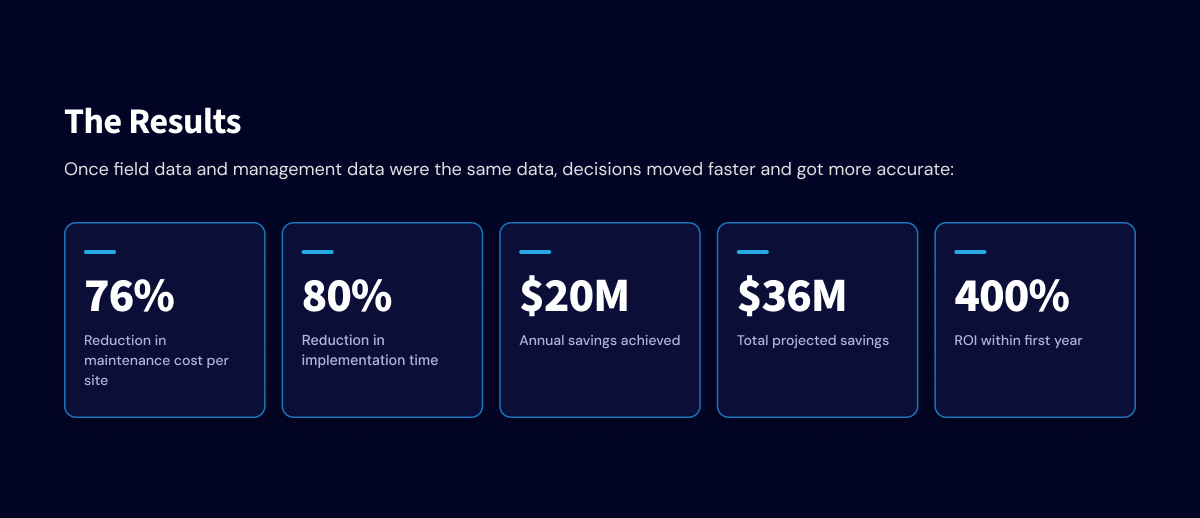
Once field data and management data were the same data, decisions moved faster and got more accurate:
Those numbers echo what McKinsey has found elsewhere in the sector. A chemicals company that adopted digital work management saw a 30% productivity gain in maintenance planning and doubled its on-schedule task completion. An offshore operator running a similar predictive maintenance push cut downtime 20% and added more than 500,000 barrels of annual production. The pattern holds because the underlying fix is the same one: stop treating maintenance data as a report to file, and start treating it as a live operating system.
Routine maintenance does not need more sensors or more dashboards for their own sake. It needs one governed, real-time source of truth that field workers and executives are both looking at, at the same time. That shift, from the report from last week to the number right now, is what turned a $20M-a-year problem into a $36M win.
Explore how Aligned Automation helps chemical and petrochemical manufacturers turn routine operations into a real-time system of record.
Most sites still track maintenance through manual logs and site-specific spreadsheets. Reports get compiled and passed up the chain on a weekly cycle, so by the time leadership sees a number, it can already be a week or more old.
Siemens' 2024 True Cost of Downtime report estimates unplanned downtime at $1.4 trillion a year across the world's 500 largest companies. In chemicals and oil and gas specifically, a single hour of downtime can cost hundreds of thousands of dollars.
Automating KPIs like equipment readiness, delay reporting, and mobility utilization gives every site the same live view instead of a delayed retrospective report, so issues get caught and acted on before they compound into bigger, costlier problems.
Technicians often work in areas with weak signal. Offline-capable tools let them log an issue the moment they find it at the machine, with the data syncing automatically once they reconnect, instead of writing it down and entering it hours later at a desk.







.svg)