Waste, markdown depth and promotion timing set per product line, not per campaign.
Protect Revenue and Margin Across Every Store
AAxon RetailSense brings lost sales, promotions, pricing, expiry and disruptions like weather, events and cyber incidents into one view. AI agents recommend the next action. Your team approves it.
Sense it. Decide it. Act on it.
RetailSense Command CenterIllustrative view
Lost salesDemand the shelf never recordedRaise orders in 34 stores where demand went unrecorded
PromotionsOffers that pay back across the categoryRun a 12% offer in 84 stores near schools
Competitor pricingStores genuinely exposed to a price cutMatch the price in 9 exposed stores only
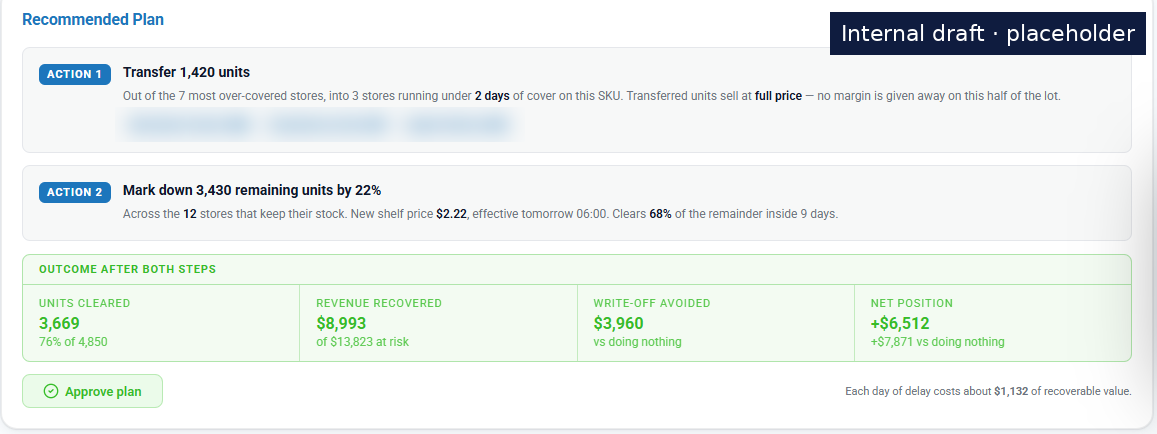
Near expiryStock unlikely to sell in its shelf lifeTransfer 1,420 units, then mark down the rest by 22%
Fresh orderingOrders sized to true demand and shelf lifeTrim tomorrow's produce order in 12 stores
DisruptionsWeather, local events and cyber incidentsPause orders to 6 stores with a refrigeration fault
Recommended action awaiting approval
What is your sales data not telling you?
Most CPG reporting only sees what was scanned at the till. Empty shelves, wrong stock records and over-deep promotions stay invisible, so forecasts learn the wrong lesson.
39%
of shoppers switched brands when an item was out of stock.
McKinsey & Company, consumer survey, 2021
60%
of SKUs carry inaccurate inventory records, so replenishment never triggers.
ECR Retail Loss, Inventory Inaccuracy in Retailing, 2019
75%
of CPG promotions don't break even once the full cost is counted.
Nielsen, analysis of 39M promotional events, 2014
See RetailSense in action
A short walkthrough of the Command Center, from a flagged stockout to an approved order.
From systems that record to systems that decide
Dashboards show what happened. RetailSense checks every product in every store, every day, and tells your team what to do next, ranked by value, confidence and urgency.
01
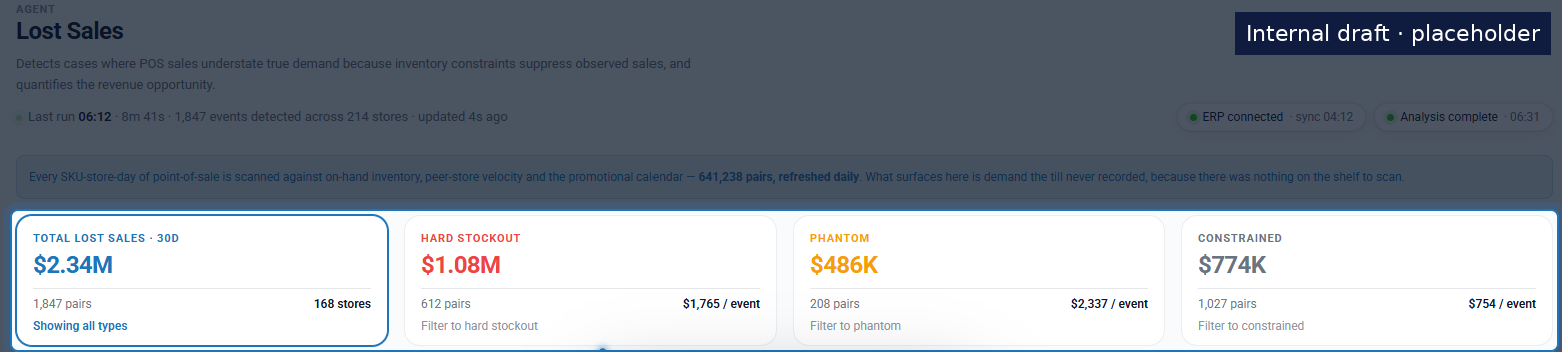
Find lost sales and true demand
Separate hard stockouts, phantom inventory and constrained demand, and see the dollar value of each. Corrected demand goes back into history, so the forecast stops repeating the gap.
02
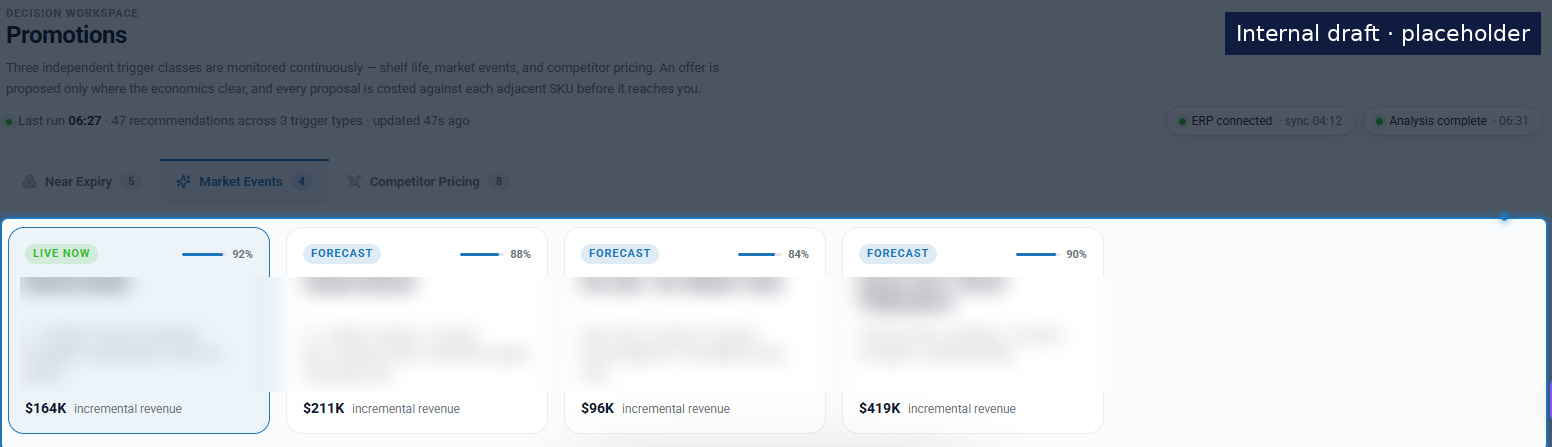
Plan promotions that pay back
Trigger offers from what actually moves demand, like holidays, weather and local events. Test the discount depth in a simulator and see the margin before anything launches.
03
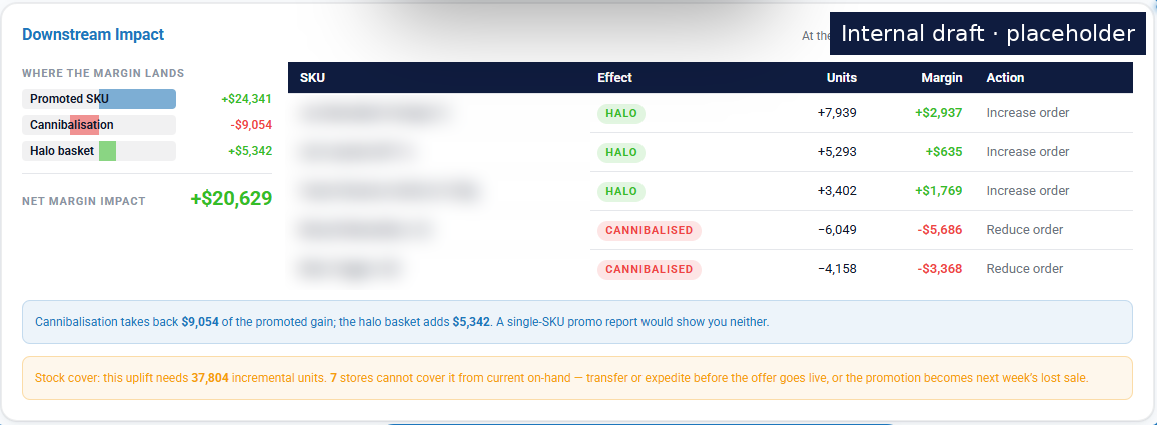
See the whole category, not one product
Every offer is costed against the products on the same shelf, so halo and cannibalization show up before launch, along with the stores that need more stock.
04
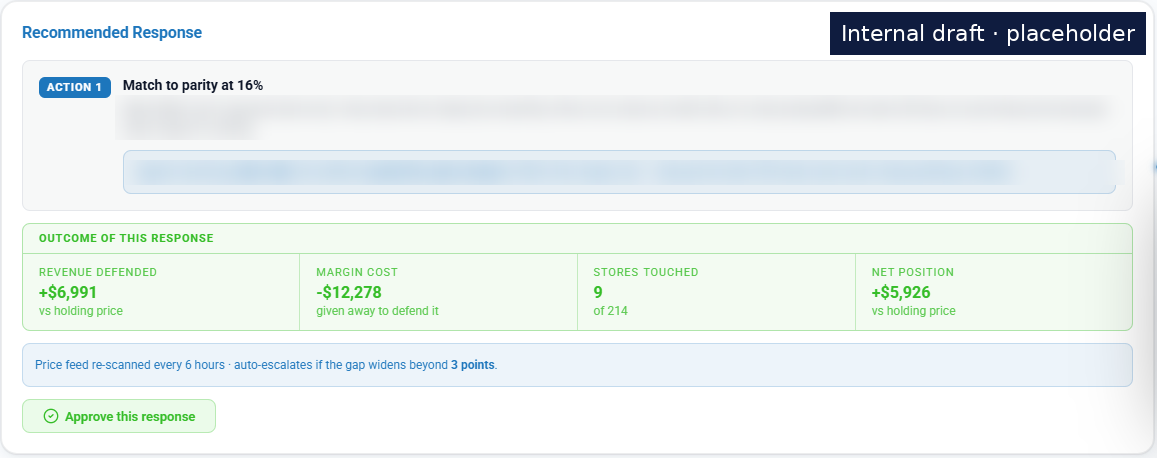
Respond to competitor prices where it counts
When a competitor cuts a price, RetailSense finds the stores that are genuinely exposed and matches only there. You defend the same revenue for a fraction of the margin.
05
Clear near-expiry stock with less markdown
Move stock to stores where it will sell at full price first. Then mark down only what's left, sized to clear it before it expires.
Ready for the day that doesn't go as planned
A heatwave, a local event or a cyber incident can wipe out stock overnight, as supermarkets across Europe saw in November 2026. RetailSense helps your team respond in hours, not weeks.
See the exposure
Which products, stores and dollars are at risk, as soon as the disruption is flagged.
Contain the loss
Move stock out of affected stores, pause orders into them and redirect supply to where it will sell.
Recover demand
Rebuild orders and promotions so shelves refill without over-ordering, and keep the disruption out of the forecast.
One engine across the planning cycle
RetailSense starts with the decisions that cost you most today. The same data and agents then extend across the rest of planning, so each new use case builds on the last.
In RetailSense todaySame engine, extends to
Sense
What is really happening
- Lost sales and hidden demand
- Outlier and anomaly management
- Demand sensing across every store
Plan
What to do about it
- Promotions, markdowns and near-expiry
- Demand forecasting and planning
- Assortment and price elasticity
Order
How much, where and when
- Fresh and short-life ordering
- Replenishment settings and reorder points
- Inventory balancing and store transfers
Supply
Who delivers, and how well
- Supplier constraints in the order
- Vendor fill rate and service cases
- Purchase and receipt exceptions
Specialist agents recommend the next best action, your people make the call
Every recommendation follows the same path, from your data to a named owner's approval.
- Your data
ERP, point-of-sale, pricing, promotions, shelf life, competitor prices, weather and holidays.
- Validated
A signal agent checks and joins every source before anything is analyzed.
- Specialist agents
Demand, expiry, pricing and promotion agents each build a recommendation using your rules.
- Human approval
A named owner sees the confidence score, the evidence and the options rejected, then accepts or declines.
- Written back
Approved actions go to your ERP, and results feed the next recommendation.
What changes when decisions are yours
Industry benchmarks for agentic decisioning in retail and CPG. We re-measure each one on your own data in your first Automate30 cycle.
Orders sized to true demand and shelf life, so less stock sits idle. A 2-day fig is not a 14-day potato.
Fewer emergency orders and transfers, because stock is placed right the first time.
One use case. Thirty days. Then the next.
Automate30 gets your first RetailSense use case running on your own data within 30 days. Every cycle after adds the next, from more categories to more regions, through Ignite, Accelerate and Operate.
Define the use case
Pick one use case, like lost sales in one category, and agree the outcome you'll measure.
Launch in 30 days
Connect your ERP and POS data, configure the agents and validate the first recommendations with your team.
Measure, then repeat
Measure value, adoption and reliability, then start the next 30-day cycle on what's working.
Find the competitive advantage hiding in your data
Thank you! Your submission has been received!
Oops! Something went wrong while submitting the form.